
How Execution Reputation is earned (and how it is not)
Reputation on Africoders comes from completed work, peer signals, and verified contribution — not self-written claims.
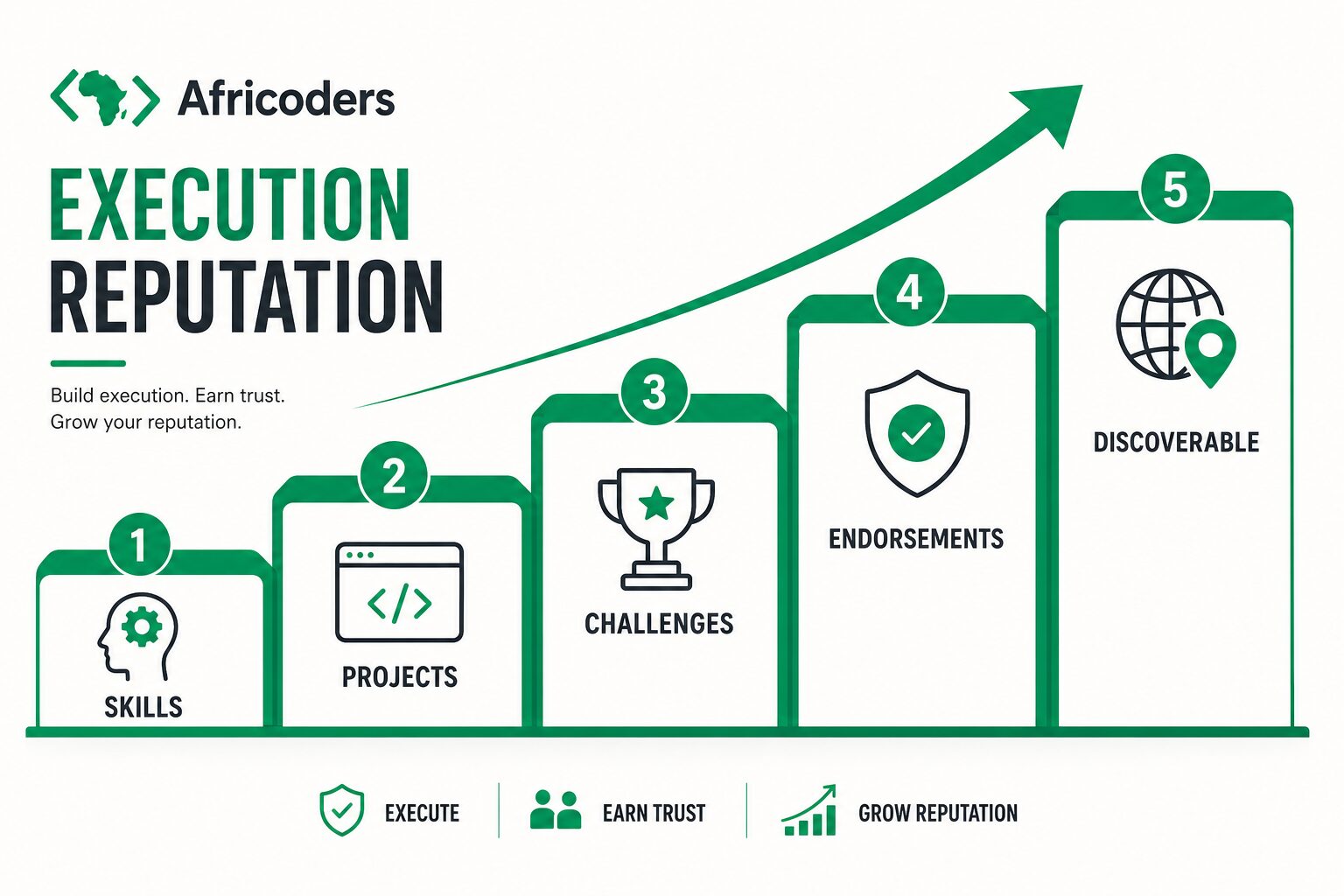
Execution Reputation is Africoders’ way of summarising whether you finish meaningful work. It is designed to reward evidence, not volume of posts — so builders across African cities can compound trust without performing on a public social feed.
Reputation is a lagging indicator: you earn it after the demo runs, the collaboration delivers, and peers can point to something concrete. That design protects the network from empty self-promotion while still helping strong shippers get discovered across African cities without performing on a public social feed.
What counts
- Shipped projects with clear outcomes
- Challenge completions and peer reviews
- Collaboration contributions with agreed deliverables
- Endorsements tied to skills you have demonstrated
Activity without artifacts does not move the needle. A busy week of chatting is not the same as a delivered slice.
Mentorship conversations help, but they compound only when you ship the agreed next action and link it to Passport. Founders reading Passports should look for recent demos, honest constraints, and evidence of finishing under a brief — not follower counts imported from elsewhere. Challenges with reviewable submissions are especially strong because they share a brief and a deadline.
What does not count
- Empty skill lists with no linked work
- Copy-pasted CV bullets without demos
- Vanity metrics scraped from social feeds
- Self-awarded titles without corroboration
- Tutorial clones presented as production systems
Takeaway: Reputation is a lagging indicator of finished work — you earn it after the demo runs, not when you announce the idea.
Announcing a startup idea in community chat is fine. Treating the announcement as proof is not. Proof starts when someone else can click, run, or review. If your week was full of tabs and empty of links, Execution Reputation should stay flat — that is the system working.
How to improve it deliberately
Pick one role you want. Ship one visible artifact every two weeks. Ask for one specific endorsement after a collaboration. Link everything back to your Passport.
Consistency beats intensity. A quiet month of finished slices beats a loud weekend of abandoned starts.
Align challenges to your Builder Roadmap so each deadline produces career-shaped proof instead of random badges. Use Aurora when you stall: name persona, target role, weekly hours, and ask for one next artifact. Schedule the Passport update before you write the first line of code so publishing is part of definition of done.
Reading your own reputation honestly
If opportunities are not appearing, inspect gaps: stale demos, mismatched headline, zero challenges, or privacy settings that hide what you meant to publish. Ask Aurora for a gap check with your persona and target role named explicitly.
Compare Aurora’s gap check to what a recruiter would see in thirty seconds. Fix the surface — headline, demos, visibility — then resume applications. Do not confuse “I am learning a lot” with “I have published proof.” Learning matters in Learn; reputation cares about Earn-stage artifacts.
Also check whether your proof matches the market you want. A strong mobile Passport will not convert for backend roles until you publish a bridge artifact.
Team and founder implications
Founders and recruiters should score Execution Reputation as prior odds — then validate with interviews. It is a signal, not a hiring decision by itself. Pair it with a paid trial or pairing session for critical path roles.
Pair reputation with a two-day paid trial for critical path roles. You will learn more about communication and delivery than a week of whiteboard trivia — especially when candidates span African time zones and need async-friendly evaluation. Inside your company, celebrate finished demos in stand-ups, not only idea pitches.
When you endorse or review others, you shape the network’s signal quality. Specific, artifact-linked feedback raises trust for everyone in the collaboration graph.
Closing
Reputation compounds slowly — and that is the point. Ship one Passport-linked artifact in the next fourteen days and let evidence, not announcements, move the score. Then ask one collaborator for a skill-linked endorsement while the work is fresh, and link both the artifact and the endorsement on your Passport.
Topics
Related reading
View all