
Ship in public: a practical challenge workflow
Challenges are not vanity metrics. Use them to create credible signals recruiters can verify.
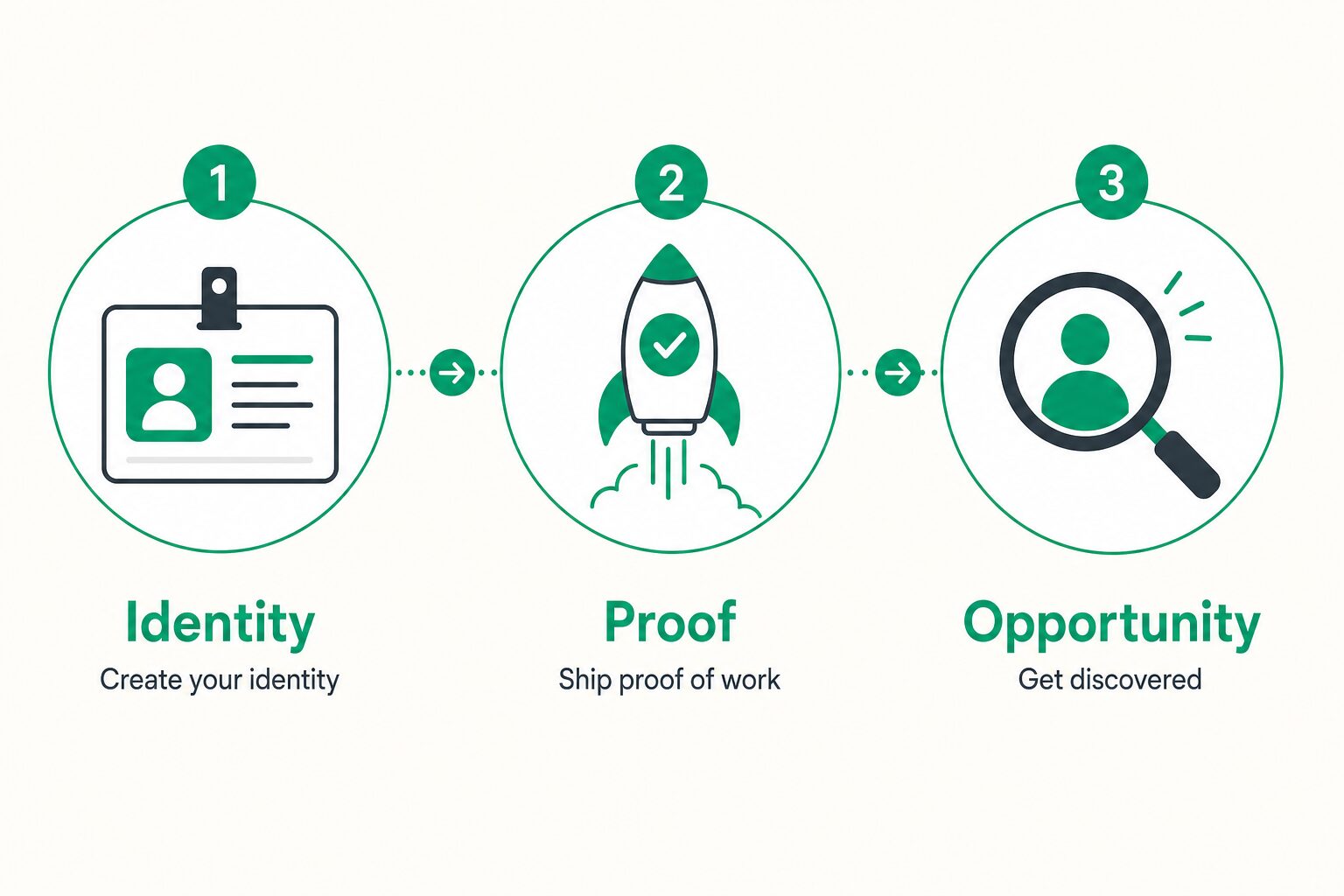
Challenges give you a bounded problem, a deadline, and a place to publish proof. Used well, they become Passport chapters — not badges you collect and forget. This workflow turns a challenge into durable career signal.
Used well, challenges become Passport chapters — not badges you collect and forget. They give Career OS a deadline-shaped Build step that feeds Earn. This workflow turns a challenge into durable career signal recruiters can open without cloning your laptop.
A weekly shipping loop
- Pick a challenge aligned with the role you want
- Break it into daily commits or demos
- Publish a short build note when you hit milestones
- Submit with a runnable link and honest constraints
Keep scope inside the brief. Overbuilding past the deadline is how demos break.
Put the Passport link on your calendar before day one so publishing is not an afterthought. If power or connectivity is unreliable, plan offline-capable commits and a single upload window. Overbuilding past the deadline is how demos break — scope to the brief, then polish one happy path.
If the brief asks for a checkout flow, do not also invent a loyalty programme on day six. Scope discipline is how demos stay runnable under deadline pressure.
What good submissions include
- A working demo or repository
- A short note on trade-offs you made
- What you would improve with another day
- Honest stack and constraints
- Seed or login notes if the reviewer needs them
Takeaway: Reviewers hire judgment. Show what you cut and why.
Reviewers hire judgment. Show what you cut and why, including Africa-aware constraints when relevant: mid-range Android, expensive data, local payment rails, or multilingual copy. Seed notes and login credentials save reviewers from bouncing off an empty state.
Add a one-sentence outcome a non-engineer can understand. Recruiters often forward demos to hiring managers who will not read your entire README.
After you submit
Link the outcome to a Passport project. Ask for one peer review. Mention the challenge in applications only when the demo still runs.
Set a calendar reminder to re-check hosted demos monthly.
Mention the challenge in applications only when the demo still runs. Set a monthly reminder to re-check hosted demos. Ask for one peer review or specific endorsement while context is fresh — that is how Execution Reputation compounds from a single brief.
Dead challenge links quietly erase the reputation you earned when you submitted. Set a monthly reminder to re-check hosted URLs.
Choosing challenges strategically
Backend roles → API and data briefs. Design roles → UX and prototype briefs. Fullstack → end-to-end slices with clear definition of done. Ignore trendy challenges that do not match your roadmap.
Open Career Explorer and your Builder Roadmap before you browse the challenge board. Ignore trendy briefs that do not match the role you want next. Fullstack paths need end-to-end slices with clear definition of done; design paths need prototypes with rationale, not only moodboards.
If Aurora and your Builder Roadmap point to mobile, do not spend a month on an unrelated trendy brief for “exposure.” Alignment compounds faster than novelty.
Avoiding common failure modes
- Starting three challenges and finishing none
- Submitting screenshots of localhost with no repo
- Hiding trade-offs behind marketing language
- Never linking the result back to Passport
Aurora can help you pick one challenge and refuse the rest for the month. Starting three and finishing none trains the wrong habit. Screenshot-only submissions without a repo waste reviewer time and quietly damage trust when someone asks to clone.
One finished challenge per month beats a graveyard of 40% attempts. Finish, link, review — then pick the next brief.
Closing
Consistency compounds — one finished challenge beats five abandoned starts. Join one aligned challenge this week and schedule the Passport link before you write the first line of code. Join one aligned challenge this week, schedule the Passport link before you write the first line of code, and treat the submission README as interview prep.
Topics
Related reading
View all